
Beyond the 9-to-5: How Gig Work is Redefining the Future of Employment in South Africa

Topic Category: Economics
Last week, the latest Quarterly Labour Force Survey (QLFS) for Q1 2026 from Stats SA paints a sobering picture of the South African economy. While the numbers are challenging, they also reveal a fundamental shift in how the next generation is forced to interact with the world of work.
The Headline Numbers: A Deepening Crisis
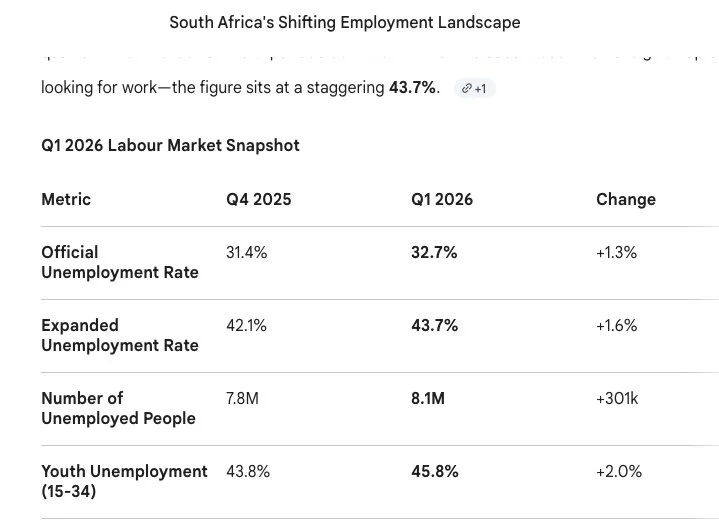
The official unemployment rate has climbed to 32.7%, up from 31.4% in the previous quarter. This isn't just a statistical nudge; it represents a loss of roughly 345,000 jobs in a single quarter. When we look at the expanded definition—which includes those who have given up on looking for work—the figure sits at a staggering 43.7%.
Q1 2026 Labour Market Snapshot
Unemployment Analysis
Key Themes and Growth Trajectory
The trajectory is currently one of "jobless growth" or, more accurately, contraction in key labour-absorbing sectors. The largest losses were seen in industries that traditionally provide entry-level opportunities, which has directly fed into the youth crisis.
One of the most concerning themes is the NEET rate (Not in Employment, Education, or Training). Nearly 4 in 10 young people aged 15–24 are completely disengaged from the formal economy and the educational pipeline. This suggests that the "growth trajectory" is not just slow; it’s diverging, leaving a massive portion of the population behind as the economy attempts to modernise.
Necessity as the Mother of the "Side Hustle"
In this climate, freelancing and "side hustles" have transitioned from trendy buzzwords to essential survival strategies.
The Survivalist Gig: For many, the gig economy isn't about "flexibility" or "work-life balance"—it’s about the high cost of living and the lack of traditional 9-to-5 roles.
Digital Integration: We are seeing a boom in platform-based work, from delivery services to digital micro-tasking.
The "Portfolio Career": Younger South Africans are increasingly maintaining multiple small revenue streams (selling goods online, freelance content creation, or tutoring) because a single employer no longer provides the security it once did.
This shift indicates a move toward an informal-digital hybrid economy. While this offers a safety net for some, it lacks the benefits and stability of formal employment, creating a new class of "vulnerable" independent workers.
The Future of Employment: Youth at the Crossroads
With youth unemployment (15–24) sitting at 60.9%, the future of work in South Africa is being rewritten by necessity.
Entrepreneurship by Default: Since the formal market cannot absorb the 42.2 million working-age individuals, the "employee mindset" is being replaced by a "hustle mindset."
The Skills Mismatch: The data shows youth are concentrated in low-skilled service sectors. The future requires a pivot toward digital literacy and technical skills that can be exported globally through remote freelancing.
Policy Pressure: The rising numbers will likely force a rethink of labour laws and social grants. There is a growing call for a "Basic Income Grant" or more aggressive youth employment incentives to prevent a permanent "lost generation."
South Africa is essentially becoming a lab for the future of work in developing nations: a place where traditional job security is disappearing, and the youth must navigate a high-stakes digital frontier to make ends meet.
