
Beyond Borders: The Macroeconomics and Realities of Irregular Migration
Topic Category: Economics of Migration
Human movement is as old as civilisation itself, yet irregular or undocumented migration remains one of the most complex geopolitical and macroeconomic flashpoints of our time. To address it constructively, policy-makers, business leaders, and communities must look past emotive rhetoric and examine the structural economic forces that compel millions to cross borders outside formal legal frameworks.
At its core, irregular migration is a rational human response to sharp geographic disparities in economic capital, security, and institutional stability.
The Global Blueprint: Causes, Effects, and the Need for Remedy
Irregular migration does not happen in a vacuum. It is dictated by distinct global forces that create an inevitable momentum across borders.
1. Structural Drivers (The Push and Pull)
The Push: Chronic youth unemployment, political instability, systemic corruption, and increasingly, climate-induced economic displacement in developing nations. When a local economy fails to offer a baseline of survival, migration becomes an act of economic preservation rather than a choice.
The Pull: Structural labor shortages in wealthier receiving nations. Developed and emerging economies often exhibit a deep reliance on low-cost labor in sectors that native workforces frequently avoid, such as agriculture, hospitality, logistics, and domestic service.
2. The Macroeconomic Trade-Offs
From a strict economic standpoint, undocumented migration operates as a form of market arbitrage.
Labor Arbitrage: The process where businesses capitalize on wage differentials between different regions, sometimes utilizing undocumented workforces to maintain ultra-low operational margins.
While this informal labor keeps consumer prices artificially deflated in highly competitive sectors, it builds a dual labor market: a highly regulated, tax-paying formal tier and a vulnerable, unmonitored informal tier. This disparity can erode baseline labor standards, depress low-skilled wages, and inadvertently incentivize non-compliance among businesses.
Furthermore, while irregular migrants actively contribute to the fiscal pool through indirect taxes like Value-Added Tax (VAT), their exclusion from formal income tax frameworks creates localized friction over the funding, capacity, and consumption of public infrastructure.
3. The Need for Global Remedy
Traditional, isolationist approaches—such as relying solely on physical barriers—frequently treat the symptoms rather than the disease. A sustainable global remedy requires a transition toward highly integrated, rules-based migration paths. This involves establishing realistic, market-driven legal channels for low- and mid-skilled workers, paired with strict corporate accountability to eliminate the financial incentives for illegal exploitation.
The African Lens: Debunking the Exodus Myth
When analyzing the African continent, global media outlets frequently paint an inaccurate picture of a mass exodus directed entirely toward Europe or North America. The data tells a fundamentally different story.
Of the tens of millions of Africans living outside their countries of birth, over half stay within the continent. Most continental migration is highly regional, flowing toward dominant sub-regional economic hubs that act as powerful centers of gravity for regional talent, trade, and labor.
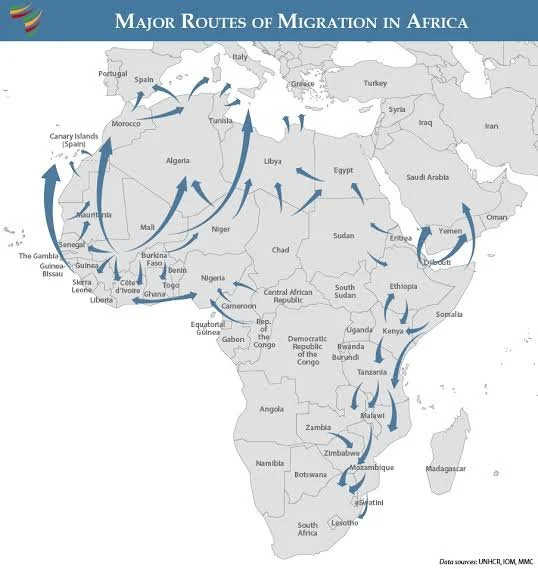
Major Migration Corridors Across Africa. Source: Africa Center for Strategic Studies
As the map illustrates, human mobility within Africa is characterized by complex internal corridors, with southern, western, and eastern economic hubs pulling the majority of intra-continental migrants.
The South African Paradigm: High Stakes and the June 30th Flashpoint
South Africa stands as the ultimate case study for these intra-continental dynamics. As the most industrially diverse economy in the Southern African Development Community (SADC), the nation hosts an estimated 3 to 4 million international migrants (this number is apparently MUCH higher). In a slow-growth economic environment characterized by devastatingly high structural unemployment and stretched public services, irregular migration has become a major lightning rod for deeper socio-economic frustrations.
This friction is reaching a critical tipping point on the ground, driven by a sharp divergence between formal state policy and grassroots civil action.
The June 30, 2026 Deadline: Civil Ultimatum vs. Legal Reality
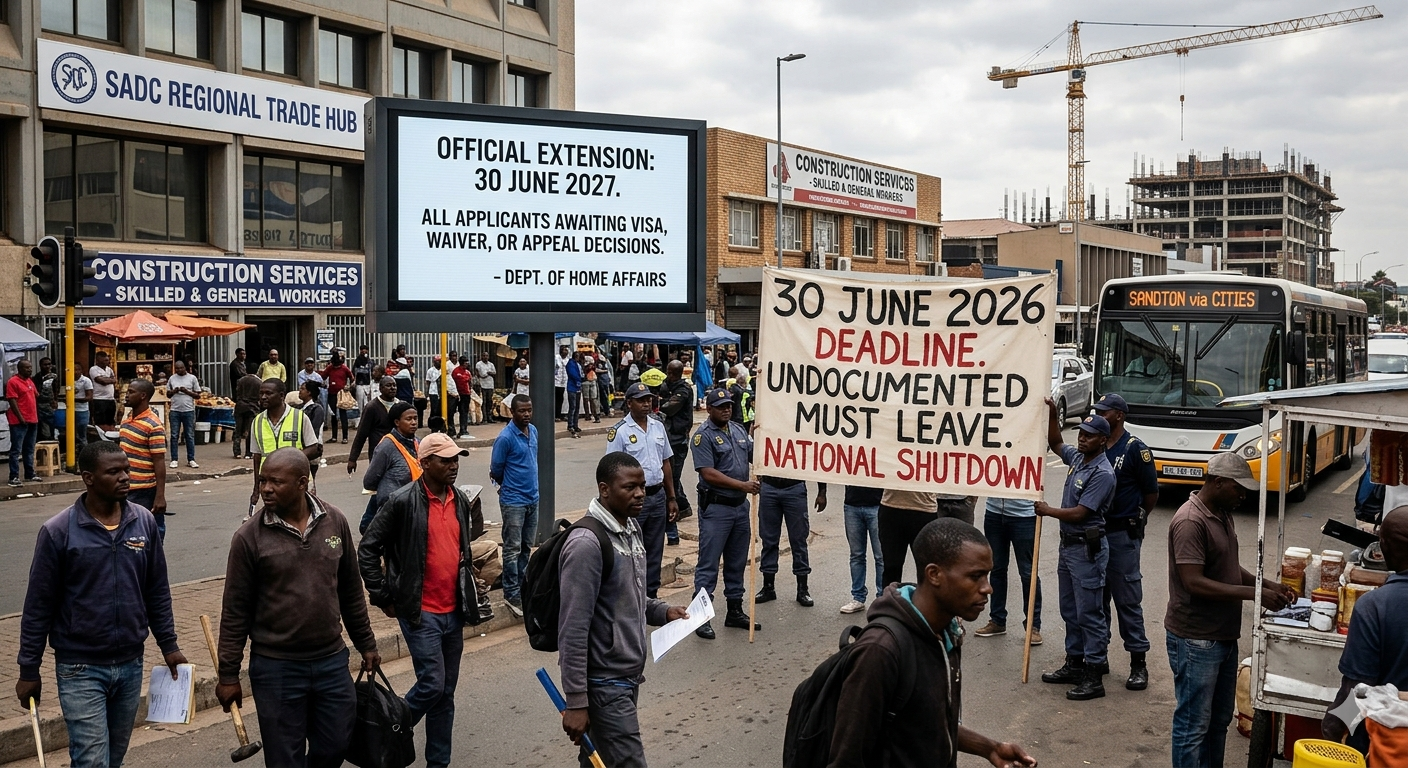
The intersection of economic anxiety and immigration policy has culminated in a high-stakes standoff centered around a self-declared 30 June 2026 deadline.
A coalition of private anti-immigration movements and civil society groups has issued a public ultimatum demanding that undocumented foreign nationals leave South Africa by June 30, warning of a national shutdown and mass protest marches if the demand is not met. This arbitrary deadline has triggered widespread concern over potential instability, forcing the South African Police Service (SAPS) to place specialized riot units on high standby.
This private ultimatum highlights a profound systemic disconnect when contrasted with the actual mechanics of the state:
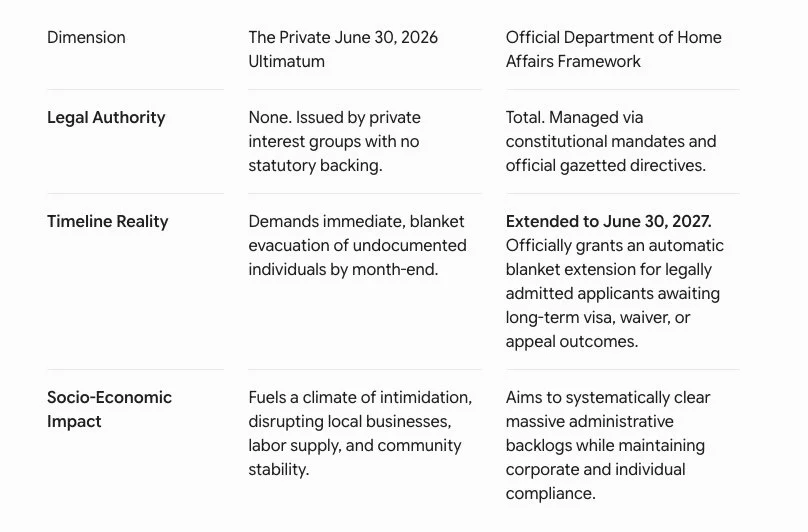
President Cyril Ramaphosa has explicitly sought to calm the mounting public tension, warning that members of the public cannot take immigration enforcement into their own hands and that only authorized state officials are legally empowered to enforce the law.
The Macroeconomic Risk of "Mob Enforcement"
From an economic standpoint, arbitrary deadlines and civilian-led immigration clampdowns present severe risks to market stability. Behind the backlogs at the Department of Home Affairs are thousands of professionals, family members, and legitimate business owners who are legally inside an administrative pipeline.
When private movements disrupt this process through intimidation or forced labor ousters, they create massive operational blind spots for enterprises, threaten supply chains in key sectors like agriculture and retail, and scare off foreign direct investment (FDI) due to perceived security risks.
The Path to Long-Term Structural Remedy
Ultimately, managing irregular migration effectively requires replacing unmonitored, informal human flows with highly transparent, state-controlled, and digitally managed systems. The state is currently undergoing a fundamental legislative reset to address this:
The National Labour Migration Policy: Introducing strict sector-specific quotas for foreign nationals to protect local employment while keeping room open for critical scarce skills.
Aggressive Corporate Accountability: Shifting the burden of enforcement onto employers. Companies that exploit undocumented workers to bypass statutory minimum wages face severe legal and financial penalties, eliminating the underlying economic incentive for irregular hiring practices.
Securing the Border via the BMA: Empowering the Border Management Authority (BMA) with advanced technology and infrastructure to ensure that entries and exits occur strictly through lawful ports of entry.
The real challenge for South Africa—and the broader continent—is finding the equilibrium. Total insularity runs directly counter to the objectives of the African Continental Free Trade Area (AfCFTA), which relies on the seamless, legal movement of goods, services, and skilled personnel to drive continental industrialization. By enforcing the rule of law, protecting local labor from unfair exploitation, and completely rejecting unlawful ultimatums, economies can successfully stabilize their domestic markets while participating in regional growth.

Llewellyn Devereaux: Economist and Business Strategist
