
Beyond the Badge: Why South Africans Are Trading European Prestige for Chinese Value
Topic Category: Motor Industry
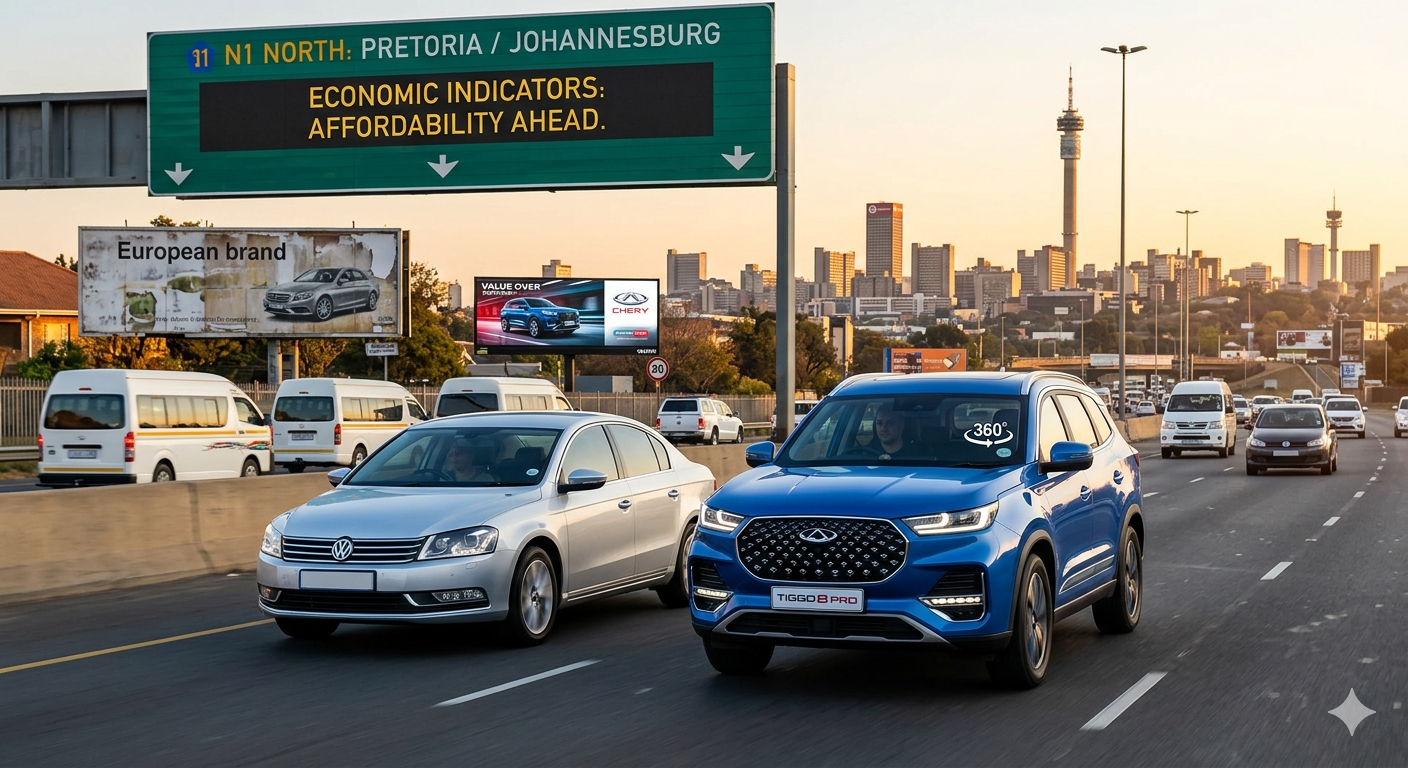
What is happening to the car industry today globally seems to be the same reality that happened to the phone companies when Apple dropped the iPhone. For decades, the South African automotive landscape was governed by an unspoken rule: brand prestige and badge loyalty were king. Owning a German hatchback or a robust Japanese sedan was a milestone of middle-class success.
However, recent data from the Automotive Business Council (naamsa) indicates that South Africa is in the middle of a massive structural reset. Driven by unrelenting economic pressures and a flood of high-tech, aggressively priced options, local car buyers are abandoning traditional brand loyalty. At the heart of this disruption is an unprecedented surge of Chinese automotive brands.
1. The Macroeconomic Squeeze and Income Reality
The disruption of South Africa's car market is fundamentally rooted in household economics. South African consumers are facing a brutal combination of high interest rates, sticky inflation, and stagnant real wage growth.
When household budgets shrink, car shopping transforms from an emotional purchase into a cold, mathematical calculation. The modern South African middle class is highly constrained by debt, with a large portion of monthly income swallowed up by home loans, rising electricity tariffs, and private security costs. Buying a new vehicle has become a luxury, forcing consumers to find the absolute maximum value for every Rand spent.
2. The Pricing Divide: European Premium vs. Chinese Value
The primary catalyst for this shift is how thoroughly European automakers have priced themselves out of the mainstream market. Over the last few years, traditional European brands have systematically shifted their focus upmarket, chasing higher profit margins on premium vehicles while abandoning the entry-level and sub-R400,000 segments.
Worse yet is the "option-list trap." When purchasing a traditional European car, features like adaptive cruise control, a panoramic sunroof, heated seats, or a 360-degree camera system are hidden behind expensive, tiered optional packages.
Chinese brands like Chery and GWM (Haval) took the exact opposite approach. They entered the sweet spot of the market—primarily compact and mid-sized crossovers—and offered these premium features as standard equipment at a fraction of the price.
Consider this stark comparison in the compact SUV/crossover segment:
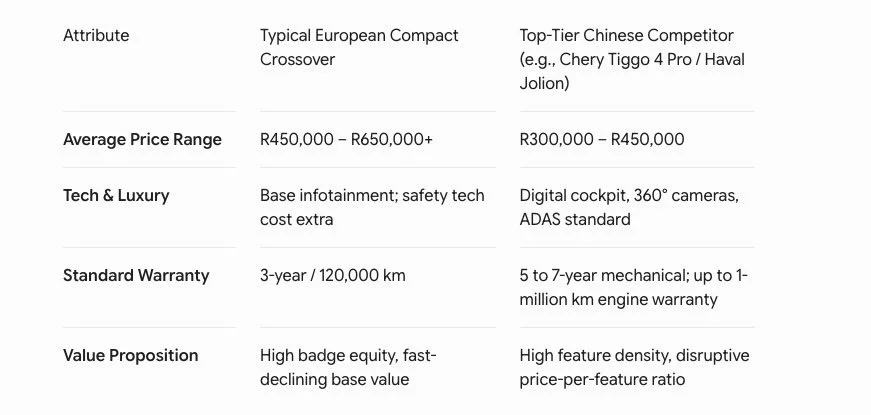
Because of this value gap, Chinese automakers expanded their share of the South African passenger car market to 16.8% by the end of 2025—up from a mere 2% in 2019. By early 2026, over 20 distinct Chinese automotive brands and sub-brands (including Omoda, Jaecoo, Jetour, and BYD) were operating in South Africa, making up nearly 40% of all automotive marques available in local showrooms.
3. The Short-Term and Long-Term Outlook
The Short-Term View (2026–2028)
Expect the Chinese onslaught to accelerate, moving heavily into the commercial sector. Brands like GWM, with its P-Series and P500 lineups, alongside new electric bakkie players like Riddara, are actively targeting the lucrative double-cab market—long considered a sacred stronghold for brands like Toyota and Ford. Additionally, as South Africa edges slowly toward New Energy Vehicles (NEVs), Chinese brands are introducing affordable plug-in hybrids (PHEVs) and electric vehicles (EVs) at prices European rivals cannot match.
The Long-Term View (2028 and Beyond)
If traditional brands do not adapt, they risk losing their volume baseline entirely, reducing them to niche players catering only to the wealthy. However, the unchecked rise of imported vehicles presents an existential risk to South Africa's domestic manufacturing sector. Local plants operated by VW, Mercedes-Benz, and BMW rely heavily on volume export contracts to Europe. If European brands continue to lose local market share, it could eventually impact the long-term viability of domestic assembly lines, which currently account for over 5% of national GDP.
4. Strategic Solutions for Legacy and European Brands
To survive this structural shift, legacy automakers cannot rely on the nostalgic appeal of their badges. They need to structurally re-engineer how they do business in Africa.
Kill the Option List (De-packetize): European brands must abandon the practice of charging extra for basic modern technology. Infotainment screens, basic driver-assist features, and reverse cameras must be built into the base sticker price to simplify the buying process and match Chinese transparency.
Leverage Local Footprints for Component Subsidies: Brands with manufacturing plants in South Africa (like VW, Mercedes, and BMW) must work with the government to leverage the Automotive Production and Development Programme (APDP). They need to redirect local manufacturing scale to subsidize and lower the retail costs of domestic passenger cars, creating an "assembled-in-SA" pricing discount.
Fight Back with Flexible Ownership: If legacy brands cannot beat Chinese rivals on the initial purchase price, they must beat them on the total cost of ownership. European brands should introduce aggressive, all-inclusive subscription models, guaranteed future value (GFV) financing, and highly localized, predictable maintenance plans that de-risk the vehicle for cash-strapped buyers.
Re-occupy the R250,000 – R350,000 Sweet Spot: Instead of completely abandoning the budget market to imports, European manufacturers must introduce or co-develop competitive, localized B-segment vehicles specifically built for developing economies.
The Bottom Line: The South African consumer has evolved. Badge equity is no longer enough to offset a massive pricing premium. If legacy brands want to defend their turf, they must stop selling prestige and start selling uncompromised value.
Which specific segment of the South African car market—such as entry-level hatchbacks, family SUVs, or double-cab bakkies—would you like to analyze next to see how the pricing dynamics compare?

Llewellyn Devereaux: Economist and Business Strategist
